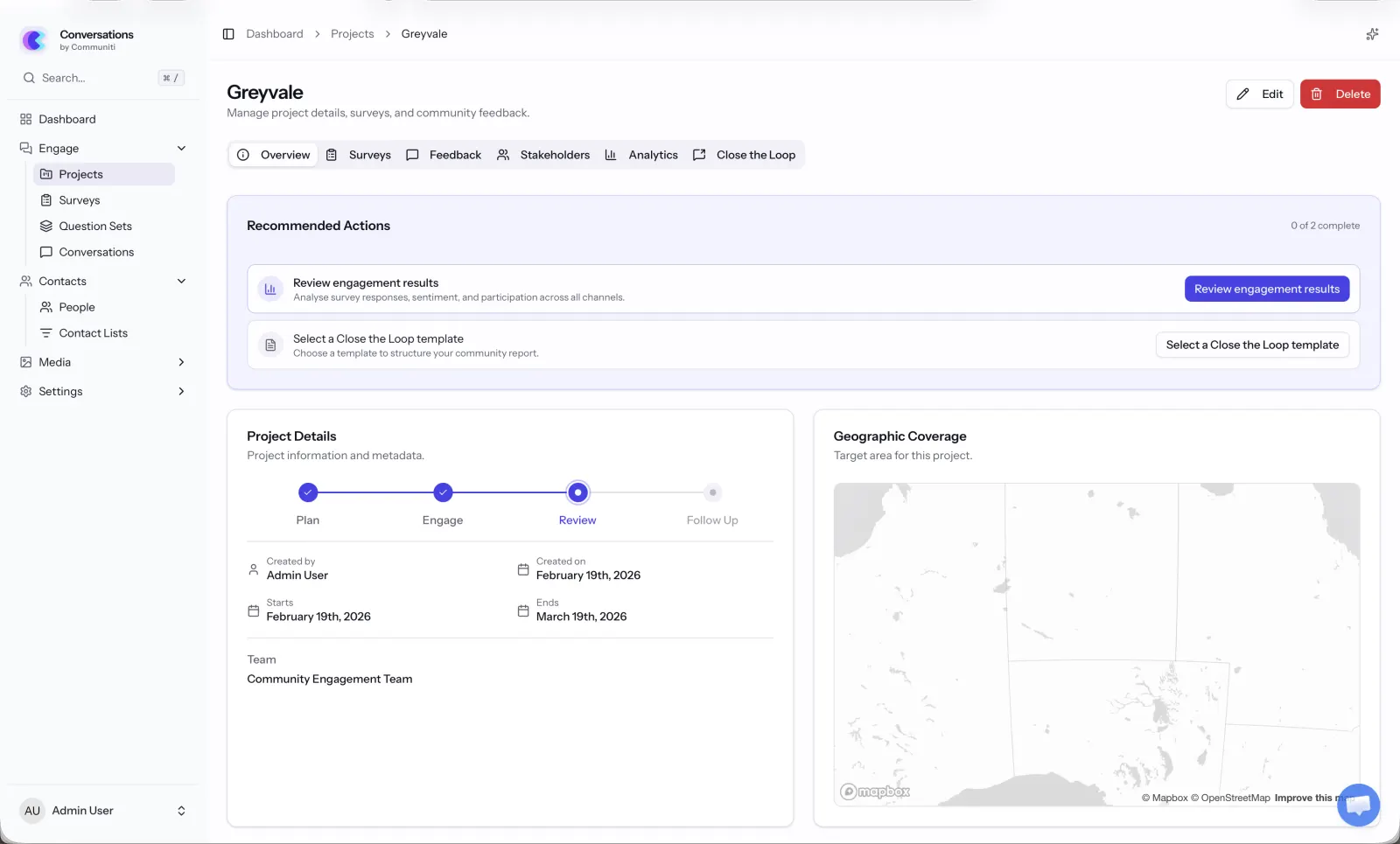
Copilot, not autopilot
AI that sharpens practitioners' judgement, never replaces it. You should finish every project knowing more than when you started.
Public trust falls when decisions happen around communities instead of with them. We're building the tools to tip the scales the other way.
Why we do this
Public trust is falling - fast. And it's not because people have become unreasonable. It's because too many decisions happen around communities instead of with them.
We saw it after Black Summer. The communities that recovered strongest weren't the ones with better comms plans - they were the ones where people felt seen, heard, and genuinely involved in what came next. We've also seen the opposite: engagement that becomes broadcast, box-ticking, performative, or non-existent. In that future, trust collapses and decisions lose legitimacy.
We exist to tip the scales toward the first future.
When we started Communiti Labs, we asked 100 practitioners across industries the same two questions: what do you love about your job, and what keeps you from doing what you love?
What we learned is that these are people people. They're driven and passionate about doing good engagement - meeting people where they are, hearing every opinion, working through hard problems, and making sure projects are delivered well and their communities are represented.
And every single person we spoke to was facing the same impossible trade-off. So much data, in so many places, in so many formats, that something always had to give: spend big to work through it all, miss voices for the timeline's sake, or push the deadline back.
We started with Analysis. We spent 2024 co-designing it with the industry - practitioners across 13 local government areas and councils shaping what it needed to be. Since then, we've kept partnering with our champions to hone Analysis and to look ahead at what tomorrow's problems will be.
We didn't start this to build something to flip. Our north star is communities that can see, clearly, that they were heard - and everything we build answers to that.
How we show up
If trust is the outcome, it has to be how we build. These aren't features - they're the standards every decision answers to.
AI that sharpens practitioners' judgement, never replaces it. You should finish every project knowing more than when you started.
In-person, paper, voicemail, any language. Voices don't count less because they're harder to capture.
Every output traces back to what someone actually said. Your team never has to say "the platform told me so."
Australian data residency, encryption in transit and at rest, and we never train on your data.
Co-designed with the industry, supported by onshore humans, delivered with unreasonable hospitality.
Follow-up as a workflow step, not a scramble. It's the difference between consultation and legitimacy.
What we build
Born from those first 100 conversations. Turns months of fragmented feedback - surveys, transcripts, recordings, paper forms - into defensible evidence in minutes, with every theme traceable back to the original voice.
Explore Communiti AnalysisEngagement across every channel - web, SMS, voice, in-person - with close-the-loop follow-up built in, so communities can see what happened with what they said.
Explore Communiti ConversationsIf you're trying to reverse the trend of distrust - we're building for you. If you're a community member who's felt ignored - we're building for you too.
And if you believe communities deserve better than being managed - we'd love to build alongside you.
Book a demo, or explore everything we're building for communities that feel heard.
Product notes, practical field guides, and evidence-led thinking for teams working under public scrutiny.